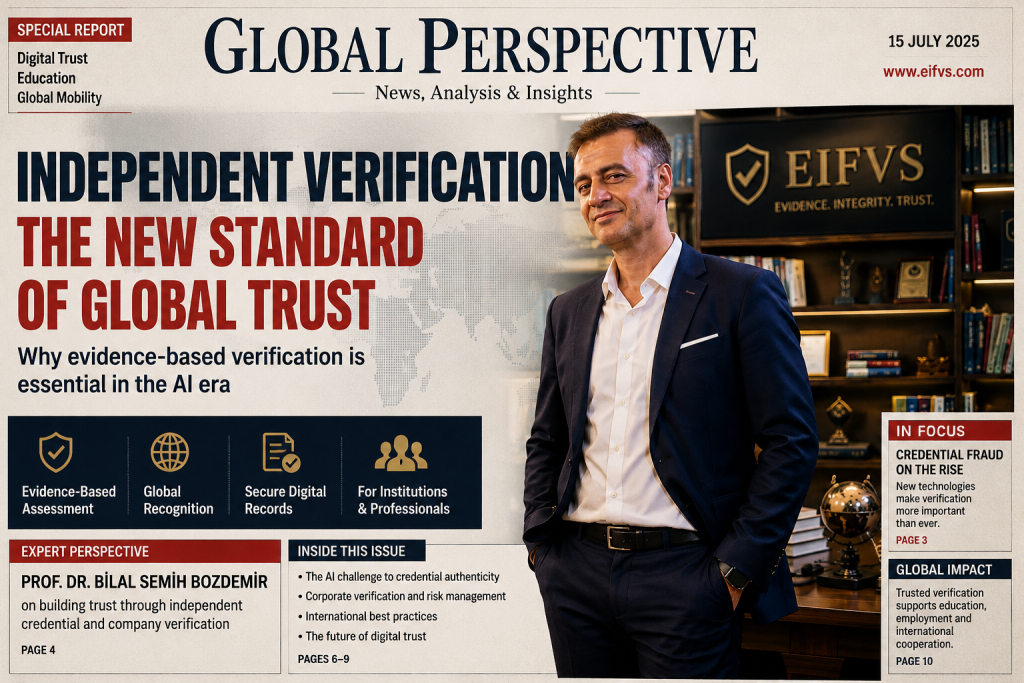
By Prof. Dr. Bilal Semih Bozdemir
As Artificial Intelligence Accelerates, Trust Becomes the World’s Most Valuable Asset
The rapid expansion of artificial intelligence, digital communication, remote education and cross-border employment has transformed the way individuals and institutions exchange information. Diplomas, professional memberships, certificates, licences and corporate records are now transmitted electronically across continents within seconds. While this digital transformation has created unprecedented opportunities, it has also introduced an equally significant challenge: determining whether the information being presented is authentic.
For universities, employers, professional organisations, financial institutions and government bodies, the question is no longer whether digital credentials will be used, but whether they can be trusted.
In recent years, sophisticated document editing software, generative artificial intelligence and increasingly convincing digital forgeries have made traditional visual inspection inadequate. Documents that once appeared difficult to falsify can now be reproduced with remarkable accuracy. Logos, signatures, seals, stamps and even official layouts can be imitated with alarming precision.
This reality requires a fundamental shift from appearance-based verification to evidence-based verification.
The Global Growth of Credential Fraud
Credential fraud has become an international concern affecting virtually every sector.
Universities must verify previous academic qualifications before admitting students.
Employers increasingly need to confirm degrees, professional licences and employment histories before making hiring decisions.
Professional associations must ensure that membership claims accurately reflect current standing.
Companies entering international partnerships often require independent confirmation of legal existence, operational status and institutional legitimacy.
The financial sector, insurance companies and compliance professionals face growing pressure to reduce fraud risks through reliable verification procedures.
As cross-border mobility continues to expand, independent verification is becoming a critical component of international trust.
Why Visual Inspection Is No Longer Enough
For decades many organisations relied primarily upon visual examination.
Does the logo appear genuine?
Does the signature look authentic?
Is the formatting consistent?
Is the seal correctly positioned?
These methods remain useful but are no longer sufficient.
Modern verification requires examining the underlying evidence supporting every claim rather than relying solely on the document itself.
Authenticity increasingly depends upon corroborating multiple independent sources rather than evaluating appearance alone.
Evidence-Based Verification
Evidence-based verification represents a structured methodology that seeks objective confirmation rather than assumptions.
Instead of asking whether a document looks authentic, the process investigates whether independent evidence supports the claims contained within that document.
This may include confirming issuing authorities, institutional status, professional standing, publicly available records, supporting documentation and other reliable sources.
Such an approach strengthens confidence while reducing the likelihood of fraudulent acceptance.
Independent Verification and Institutional Integrity
One of the most important characteristics of modern verification is independence.
Verification processes should remain objective, transparent and free from conflicts of interest.
Independent assessment improves confidence among:
- Universities
- Employers
- Professional associations
- Government agencies
- Private companies
- International organisations
Trust increases when verification is based upon documented evidence rather than assumptions or personal relationships.
Digital Verification Records
The future of verification extends beyond paper documents.
Digital verification records enable organisations to demonstrate that an assessment was conducted through a documented review process.
Rather than relying exclusively on printed certificates, secure digital records provide additional transparency regarding review status, verification scope and evidence examined during the assessment.
Such systems may significantly improve long-term confidence in international credential exchange.
Corporate Verification Is Becoming Equally Important
Verification is no longer limited to individuals.
Businesses increasingly require independent confirmation of:
- Corporate registration
- Organisational standing
- Institutional identity
- Professional memberships
- Public records
- Operational legitimacy
As international partnerships continue expanding, corporate due diligence becomes increasingly dependent upon reliable verification frameworks.
Artificial Intelligence Requires Better Verification, Not Less
Artificial intelligence is often viewed solely as a challenge.
However, AI also offers opportunities to improve verification by assisting reviewers in identifying inconsistencies, comparing records and analysing large quantities of information.
The critical principle remains unchanged.
Artificial intelligence should support professional judgement rather than replace it.
Human expertise continues to play an essential role in interpreting evidence responsibly.
Building Global Trust
International cooperation depends upon confidence.
Educational mobility, professional recognition, research collaboration and commercial partnerships all require reliable mechanisms capable of evaluating claims objectively.
Independent verification contributes to this confidence by providing structured assessment processes that reduce uncertainty while improving transparency.
As digital transformation accelerates, trust itself becomes an essential infrastructure supporting international cooperation.
Expert Perspective
According to Prof. Dr. Bilal Semih Bozdemir, the future of international credential verification lies not in producing more documents but in producing stronger evidence.
He argues that organisations should increasingly adopt transparent, evidence-based methodologies capable of adapting to rapidly changing digital environments while maintaining independence, accountability and procedural consistency.
Rather than treating verification as a simple administrative task, institutions should recognise it as an essential component of governance, compliance and international credibility.
About EIFVS
The European Informatics Federation Verification Services (EIFVS) provides independent verification services focusing on credentials, professional memberships, organisational standing and evidence-based assessment methodologies.
EIFVS supports institutions, employers, organisations and professionals seeking reliable verification processes through transparent and structured review frameworks designed to promote digital trust and international confidence.


